

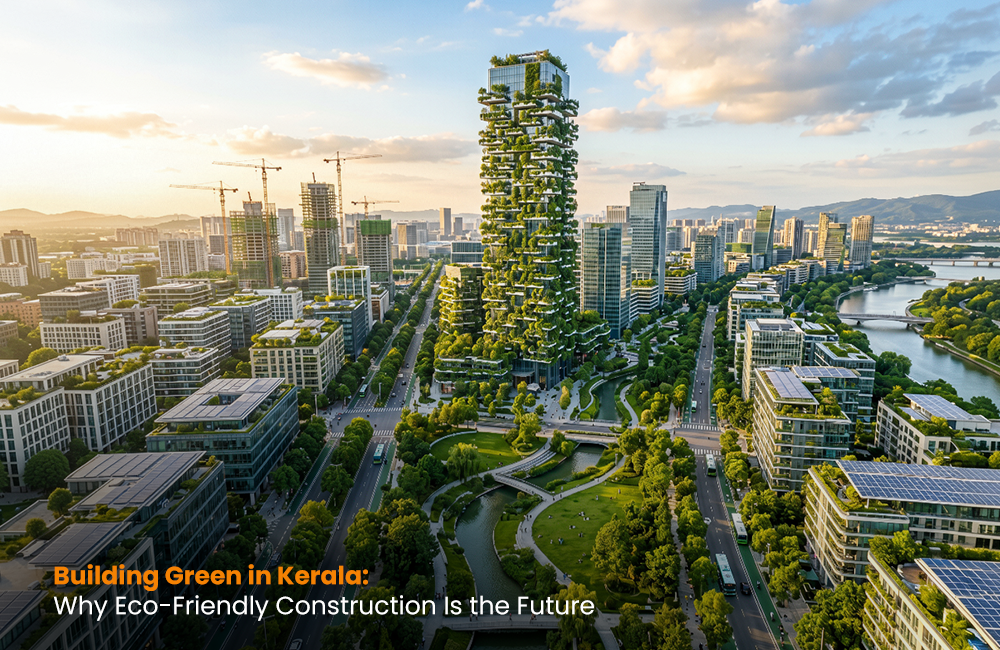
INTRODUCTION
Kerala is a state that has an identity that’s deeply rooted in its nature. The lush greenery, winding backwaters, and monsoonal climate shape how we live. But today, things are rapidly changing. The unyielding urbanization, high demand for housing, and unpredictable weather patterns due to climate issues are putting immense pressure on our land and resources. From intense summer heat trapped in our concrete buildings to sudden water scarcities, it’s the people who are feeling the crisis firsthand.
That’s why the need to build more responsibly is no longer an option but an absolute necessity.
Fortunately, there’s a quiet revolution happening across the state. More and more people are turning toward eco-friendly construction in Kerala, as it has evolved as a thoughtful approach to building homes that protect the environment while offering genuine comfort, energy efficiency, and long-term value.
Building a green home in Kerala means embracing a blend of both – our roots and modern innovation alike. It’s about using sustainable materials, designing spaces that naturally breathe with our tropical climate, conserve water, and use energy-efficient systems.
Ultimately, it’s about creating healthier, more resilient homes that don’t just sit on Kerala’s landscape, but actually belong to it.
What Makes a Construction Project ‘Green’?
Green construction principles majorly focus on the construction of resource-efficient and environmentally responsible structures that align with recognized green building standards India has established, such as GRIHA and the Indian Green Building Council (IGBC). These frameworks strictly evaluate a project based on points-based criteria to verify its actual environmental performance and long-term viability.
Any green project rests on basic criteria such as energy efficiency, water conservation and smart waste management. In practice, this means designing architectural layouts smartly, employing natural light and cross-ventilation to minimise the need for artificial cooling. It also includes the seamless integration of built-in rainwater harvesting, greywater recycling and strict construction waste management systems to minimise the overall ecological footprint of your home from day one.
Material selection is another important aspect to this process. Utilising sustainable green building materials Kerala naturally offers, such as locally sourced laterite stone, terracotta, bamboo and compressed mud blocks, significantly cuts down emissions during transportation. These materials are renowned for their excellent natural thermal insulation properties that help to keep the indoors cooler and create a resilient, robust home that is ideally suited to Kerala’s tropical climate.
Kerala’s Climate and Why It Demands Green Building Practices
Kerala has a unique geography that distinctly consists of a tropical climate and enduring monsoons – making it ideal for green homes or eco-friendly constructions.
High humidity, heavy monsoon rainfall, rising urban heat, coastal exposure, and fluctuating temperatures influence the performance of a structure over time. The alarmingly increasing urban density and the progressive reduction of green space have pushed the demand for eco-friendly, climate-responsive architectures and heat-resistant homes in Kochi substantially.
Those structures that fail to integrate climate and weather-friendly designs into their homes are most likely going to face moisture issues and poor energy efficiency and, most importantly, lead to higher cooling costs.
Sustainable Materials and Technologies Transforming Kerala Homes
The modern era has become an age of minimalism but high sophistication. People now combine eco-friendly materials with efficient building technologies to create future-ready homes. And this demand for energy-efficient homes in Kochi has homeowners adopting the new shift towards smarter design strategies and sustainable material sourcing.
At present, some of the most usable and impactful sustainable construction practices include:
• Fly ash bricks and recycled aggregates for structural work
• Solar panel integration during the construction phase
• Rainwater harvesting systems built into the design
• Natural ventilation layouts to reduce cooling load
• Low-VOC paints and sustainable wood sourcing
At GreenToday Infrastructure, we integrate sustainable construction and green practices from the very beginning itself. The materials are sourced with careful consideration and picked based on durability, environmental impact, thermal efficiency, and local suitability. The integration involves energy-efficient systems, eco-conscious finishes, and climate-responsive layouts for long-term sustainability without compromising on quality or stunning aesthetics.
The Long-Term Value: Environmental and Financial Benefits of Going Green
There is more to green construction than just checking off environmental responsibility. It has become an integral force that assures long-term energy and water savings for homeowners, through means like solar integration, natural cooling, and water-saving systems. Over time, these savings make up for the incurred investment amount, making it an ideal spend for an assured ROI.
Another notable boost that comes with green ventures is that they can effectively improve their rental and resale value since energy costs are surging and people are inclining more towards environmental standards that reduce carbon footprint construction in India.
From an environmental perspective, sustainable construction is one of humanity’s trump cards to keep in check the heavy carbon footprint that comes with India’s rapid urban growth. Green buildings aren’t just about saving energy; they are designed to help Earth breathe at a lighter pace.
In essence, by consuming fewer natural resources, reducing construction waste, and lowering greenhouse gas emissions, this approach ensures that as our cities grow, they do so in harmony with the environment rather than at its expense.
CONCLUSION
One might not realise it, but eco-friendly construction in Kerala is no longer a niche concept – it’s slowly becoming a very important aspect of urban development now. As the climate, energy demands, and environmental pressures continue to amass over time, making green construction practices the smart and future-ready choice of approach for most regions.
The future of Kerala depends on sustainable cities, responsible living, and environmentally conscious structural upgrades. Investing smartly in eco-friendly construction in Kerala is not merely a choice to work upon today but a solution to grow on for a safer tomorrow.
At GreenToday Infrastructure – Kerala’s pioneer in eco-friendly and premium construction – we help build sustainable structures responsibly and beautifully.
FAQ SECTION
Q1. What is eco-friendly construction and how is it different from regular construction?
A – Eco-friendly construction focuses on reducing environmental impact while improving energy efficiency, indoor comfort, and long-term sustainability. Unlike conventional construction, it uses sustainable materials, energy-efficient designs, rainwater harvesting, solar integration, natural ventilation, and low-waste construction methods.
Q2. Is green construction more expensive than conventional buildings in Kerala?
A – Eco-friendly construction has a higher investment in contrast to regular construction because of the materials and technologies used, like solar mechanisms or energy-efficient products. But in the long term, you will save more money than you invested.
Q3. What green certifications should I look for in a Kerala construction company?
A – Look for the following certifications:
- IGBC (Indian Green Building Council)
- GRIHA (Green Rating for Integrated Habitat Assessment)
- LEED (Leadership in Energy and Environmental Design)
Q4. Can I make my existing home more eco-friendly through renovation?
A – Definitely. The common renovation upgrades include solar panels, improved insulation and ventilation, revamped LED lights, using low-VOC paints, leveraging rainwater harvesting systems, and installing aesthetically pleasing energy-efficient windows and appliances.
Q5. What sustainable materials are commonly used in green homes in Kochi?
A – Green homes in Kochi commonly utilize eco-friendly products like bamboo, reclaimed wood, fly ash bricks, laterite stone, clay roof tiles, recycled steel, low-VOC paints and finishes.